 News
Fact check of four history claims made against Christianity on UTV's Group Chat podcast
A guest on Nana Aba Anamoah's Group Chat podcast called Christianity "deceit" and backed it with four claims about the Bible's history. One is false, two go further than the record allows, and one rests on a real fact with the wrong conclusion.
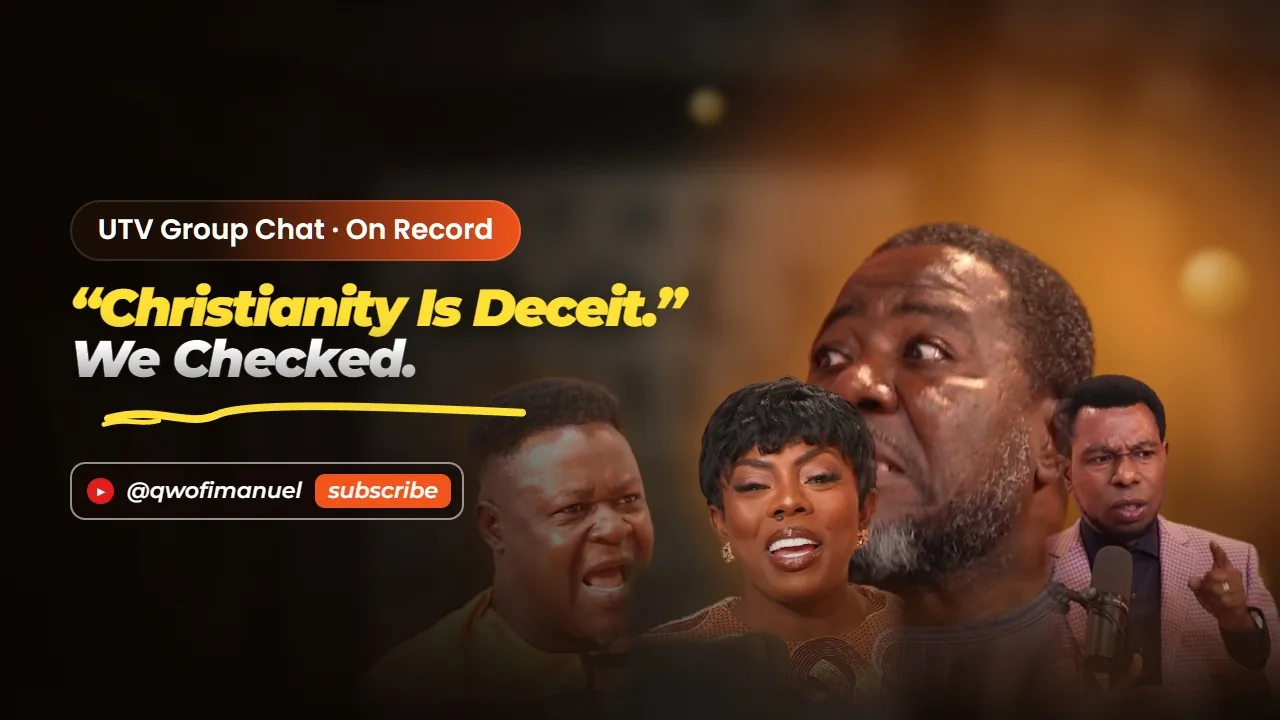
On UTV's Group Chat podcast, hosted by Nana Aba Anamoah and released on 22 October 2026, a guest told the panel: "Religion is an imprisonment. Christianity is deceit." He also made four claims about the history of the Bible. QMS checked each one against at least two sources. QMS does not name him here.
1. The letter J: true fact, wrong conclusion
The guest said the letter J was invented about 500 years ago. That is broadly right. I and J were one letter until Gian Giorgio Trissino first wrote them as separate letters in 1524, and the 1611 King James Bible spells the name "Iesus".
But the name did not start in English. It runs from the Hebrew Yeshua to the Greek Iesous, then the Latin Iesus, then the English Jesus. Greek has no "sh" sound. The change is one of spelling across languages.
2. The Council of Nicaea: false
The guest placed the council in 321 AD and said names were changed there. The First Council of Nicaea met in 325, called by Emperor Constantine, at Nicaea, now Iznik in Turkey. Modern estimates put the number of bishops at 250 to 300. The main dispute was over the teaching of Arius, which the council rejected, and the Nicene Creed came out of it.
The council's 20 canons say nothing about which books belong in the Bible. QMS found no record of names being changed there. Most New Testament books already appeared on church lists, such as the Muratorian fragment, more than 100 years earlier. The idea that Nicaea chose the Bible was repeated by Voltaire and popularised by the novel The Da Vinci Code.
3. The Slave Bible: real, pushed too far
The guest said the Bible read today is "a slave Bible". The Slave Bible is real. It was published in London in 1807 for enslaved people in the British West Indies. About 90 per cent of the Old Testament and about half of the New Testament were removed, including the Exodus story, while the verse telling servants to obey their masters was kept. Three copies are known, and one went on show at the Museum of the Bible in Washington in 2018.
That book is not the Bible used in churches today. Exodus remains the second book of every Christian Bible.
4. The 88 books: misleading
The guest said the full Bible has 88 books. Protestant Bibles have 66 and Catholic Bibles 73. The Ethiopian Orthodox Church, one of the oldest churches in the world, has the largest canon, generally called "the 81 books". Some counting methods reach 88, but no church has an official canon of 88. The 1611 King James Bible printed the Apocrypha between the Testaments, and printers later left them out. Catholic Bibles still carry most of those books.
According to the 2021 census, 71.3 per cent of Ghanaians identify as Christian.
Question your faith, question your pastor, and question me too. But in a country where seven in ten people call themselves Christian, anyone who goes on national TV and calls their faith deceit must bring clean history.
- UTV Ghana: The Group Chat Podcast with Nana Aba Anamoah (22 Oct 2026)
- Dictionary.com: "Meet the man responsible for the letter J"
- kingjamesbibleonline.org FAQ and eden.co.uk: spelling in the 1611 King James Bible
- Wikipedia: "Jesus (name)" and ancient-hebrew.org: origin of the name
- Wikipedia: "First Council of Nicaea" and fourthcentury.com: Council of Nicaea (AD 325)
- The Collector and Roger Pearse (tertullian.org): the Nicaea canon myth
- NPR (9 Dec 2018) and Smithsonian Magazine (2018): the 1807 Slave Bible
- Wikipedia: "Biblical canon"; R.W. Cowley, Ostkirchliche Studien (1974): the Ethiopian "81 books"
- Wikipedia: "Religion in Ghana", Ghana 2021 Population and Housing Census
Every factual line in this story is checked against at least two independent sources, unless the text says it comes from one report.